
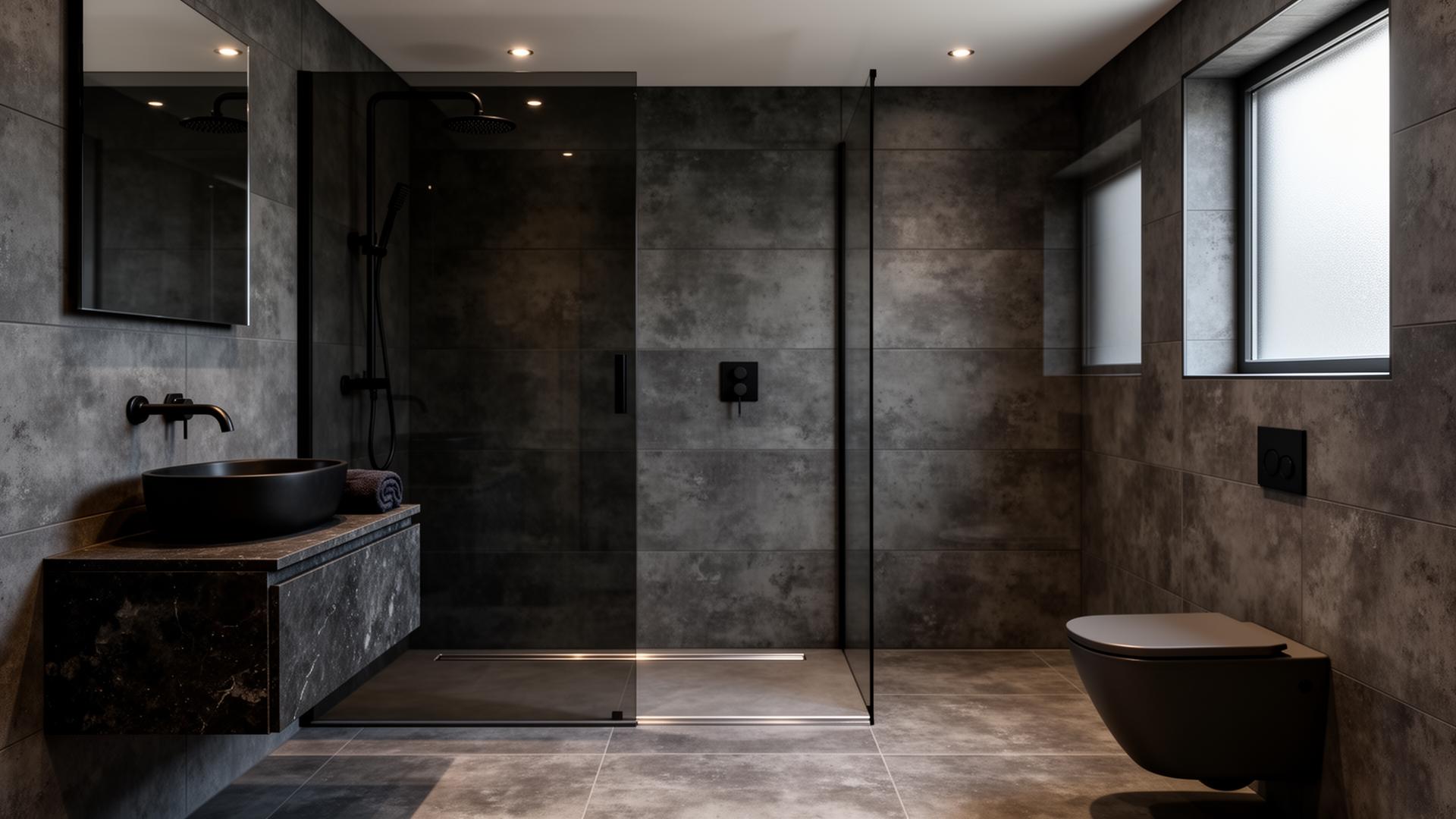
Wet room installations in Kent
Wet rooms across Kent —
properly tanked, set to fall,
built to last
Wet room design and installation across Kent and Medway. Full tanking, formed floor falls, linear drains and concealed showers — handed over with documentation, photos of the membrane and a workmanship guarantee.
What it covers
Full wet room installations — formed falls, bonded tanking, photographed handover
A wet room isn't a bathroom with the screen taken out. It's a watertight box built in place, with the floor falling to a drain, a fully bonded tanking system lapped to the walls, and every penetration detailed before a single tile goes down. Done properly, it lasts 20 years. Done badly, it leaks through the ceiling within two winters.
Our wet room work covers full installations in family bathrooms, en-suites, mobility-adapted bathrooms and luxury master suites. We form the falls in deck-screw plywood or sand-and-cement screed (depending on build-up), install a bonded tanking system to the entire floor and wet-zone walls, and detail every wall penetration — shower valve, waste, lights — as a separate junction.
Every wet room we install is photographed at tanking stage and again before tiles go on. You receive that photo record at handover, along with the tanking system's manufacturer warranty paperwork and our own workmanship guarantee in writing. If anything ever needs investigating, the record shows what's behind the tiles.
What happens if you wait
A wet room without proper tanking is the most expensive way to flood your house
When a wet room leaks, it doesn't leak like a normal bathroom. There's no shower tray to contain the water — every litre of failed sealant or missed tanking detail goes straight into the floor build-up and through whatever is below. The strip-out and rebuild typically costs more than the original installation, and insurers can be reluctant to pay for poor workmanship.
There is no patching a failed wet room. The floor, tiles, tanking, screed and sometimes joists all come back out. Budget £8,000+ to redo a wet room that's failed at 18 months.
Sustained water ingress into timber joists causes rot that goes structural fast. Bathroom failure becomes a building works project.
Many home insurance policies exclude escape of water claims arising from poor workmanship on bathroom installations. The repair becomes a private bill.
Common mistakes we fix every week
- Relying on tile grout and silicone alone — neither is a waterproofing system.
- Using a 'paint-on' tanking product on a porous substrate without a primer.
- Installing the drain before forming the falls — water pools where the floor isn't lowest.
- Penetrating the tanking membrane with screws or fixings for a shower screen after tanking is complete.
- Skipping the lap detail between wall and floor tanking — water finds the joint instantly.
- No photo record of the tanking, so failure investigation costs more than the original install.
Our process
A predictable, step-by-step system — no surprises, no upsells
-
STEP 01Free site survey
On-site measure, discussion of floor build-up, joist direction, drainage route and tile selection.
-
STEP 02Fixed-price quote
Itemised written quote — strip-out, falls forming, tanking, electrics, drainage, sanitary ware, tiling and timeline.
-
STEP 03Strip-out & first fix
Existing room removed; new pipework, waste, drainage and electrical first fix installed and pressure-tested.
-
STEP 04Form falls & tank
Floor falls formed to the drain; bonded tanking system applied to floor and wet-zone walls; photographed before tiling.
-
STEP 05Tile, second fix & commission
Slip-rated tiling to floor and walls; sanitary ware, brassware and concealed valves installed and commissioned.
-
STEP 06Sign-off & handover
Walk-around, paperwork pack including tanking warranty, photo record, Part P certification and workmanship guarantee.
What you get
Concrete outcomes — not vague promises
We form the floor falls in screed or marine ply first — drains are installed at the lowest point, not the most convenient one.
Full manufacturer-certified tanking to floor and wet-zone walls, with lapped junctions and detailed penetrations.
Photos of the tanking membrane and first fix before tiles go on — kept on file and provided to you.
Specified to suit the layout and tile size — linear drains for stone and large-format tiles, point drains for smaller mosaic finishes.
Floor tiles selected and laid for wet-area slip resistance — important for accessibility and insurance.
Workmanship guaranteed for up to 5 years from installation; tanking system carries the manufacturer's own warranty in addition.
Technical detail
The right way to build a wet room — and why most fail
Wet room failures are almost never material failures. The tanking systems on the market today are excellent — the problem is sequencing, detailing and trades who don't understand what a wet room actually is.
Form the falls first — drains follow the floor
The floor of a wet room must fall to the drain at a minimum of 1-in-50. We form the falls in either dry-screed marine plywood (for timber floors) or sand-and-cement screed (for solid floors) before tanking begins. The drain sits at the lowest point. A wet room with a level floor and a 'fall' faked in tile-bedding adhesive will pool water within a year.
Tanking is a system, not a product
Bonded membrane tanking includes the primer, the membrane itself, the bonding adhesive, the lap tapes, the corner detailing and the penetration cuffs — all from the same manufacturer. We specify and install complete systems (Schlüter, Marmox or equivalent) rather than mixing brands. Tile-backer board alone is not waterproofing.
- Manufacturer-specified primer to entire substrate
- Bonded membrane to floor and wet-zone walls (1.5m minimum)
- Lap tape to every joint, corner and floor/wall junction
- Penetration cuffs for shower valve, waste and any wall penetration
Drainage — linear vs point
The drain choice is driven by tile size and aesthetic, not personal preference. Large-format and stone tiles need linear drains because point drains require four-way falls that look poor at scale. Small tiles and mosaic finishes work fine with point drains. We'll specify the right drain at survey stage based on your tile selection.
Photographing the build — why it matters
We photograph every wet room at tanking completion and again before tiling. If anything ever needs investigating — a damp patch downstairs, a future renovation, an insurance query — the photo record shows exactly what's behind the tiles. Most installers don't do this. We do, and it's the single best protection you can have on a wet room.
Frequently asked
Straight answers to the questions Kent homeowners ask us most
How much does a wet room cost in Kent?+
A typical wet room in Kent runs from £8,000 to £15,000 depending on size, tile selection, drain spec and whether mobility adaptations are included. Stone tiling, linear drains and luxury brassware push the upper end. We give a fixed price after a free site survey.
How long will the work take?+
A typical wet room takes 2–3 weeks from strip-out to handover. Larger or more complex installations with bespoke tiling can take 3–4 weeks. The tanking system has a defined curing time that can't be rushed.
Can a wet room be installed on a timber upstairs floor?+
Yes — we form falls in marine ply or specialist deck-screw board, then apply the bonded tanking system over the top. Joist deflection is checked at survey stage; we may specify additional noggins or strengthening where needed.
Do you do mobility-adapted wet rooms?+
Yes — level-access showers, grab rails, fold-down seats, slip-rated flooring and lever taps. We can work to occupational therapist specifications or design from scratch with you.
What tanking system do you use?+
We specify complete manufacturer systems (Schlüter, Marmox or equivalent) — primer, membrane, lap tapes, corners and penetration cuffs from one manufacturer. Mixing components from different systems voids the warranty.
Do I get a record of the tanking?+
Yes — every wet room is photographed at tanking completion and again before tiles go on. The photo record is included in your handover pack, along with the manufacturer warranty paperwork.
Will the wet room be slippery?+
No — we specify floor tiles with a documented R-rating appropriate for wet areas (typically R10 or higher). Tile selection is reviewed at survey stage if accessibility is a priority.
What guarantee do you offer?+
Workmanship is guaranteed for up to 5 years from the date of installation. The tanking system carries the manufacturer's own warranty in addition — typically 25 years on the membrane itself.
What areas do you cover for wet rooms?+
Kent and Medway as standard — Rochester, Chatham, Gillingham, Maidstone, Dartford, Gravesend and Sittingbourne. Wider South East considered on a per-mile travel basis.
Related services
Areas we cover
Build a wet room that lasts 20 years.
Free site survey across Kent. Fixed price in writing. Bonded tanking, formed falls and a photographed handover, backed by a workmanship guarantee.
Fully insured · Workmanship guarantee · 7 days a week